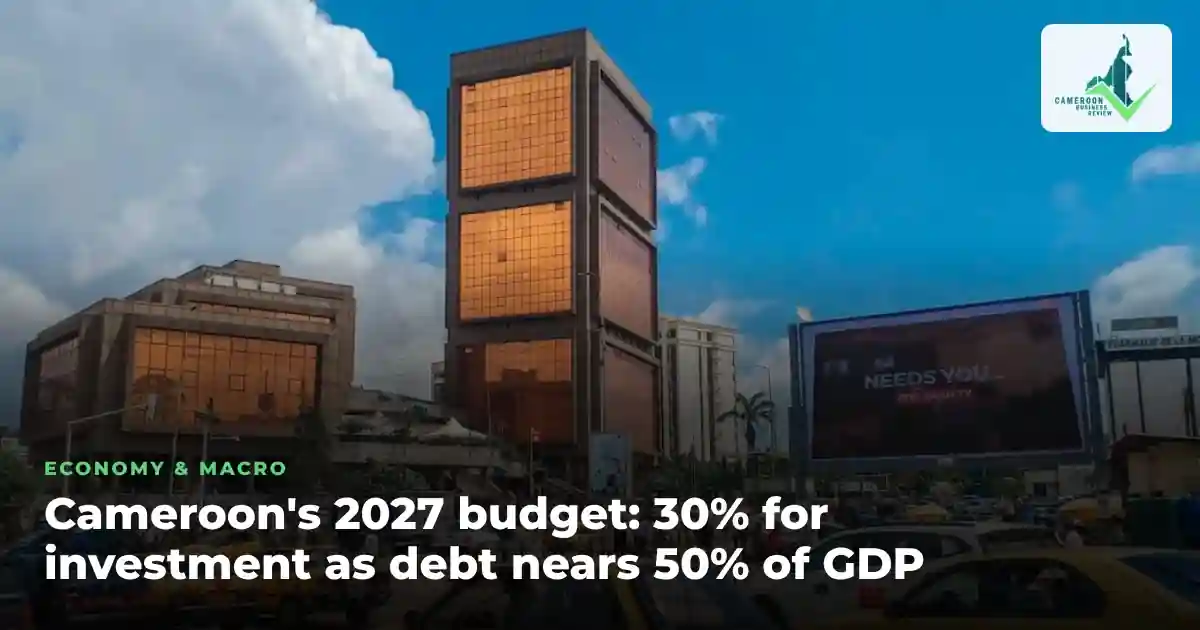
President Paul Biya has set the rules for Cameroon's 2027 budget, and the headline number is investment. The Cameroon 2027 budget circular, signed on 12 October 2026, requires that at least 30% of the general budget go to capital spending, while forecasting growth of 3.6% and a deficit of 2.7% of GDP, according to EcoMatin and Journal du Cameroun.
The 24-page circular opens the technical phase of budget preparation. Ministries and public institutions must now turn its guidance into programmes and projects before the finance law goes to parliament. It was signed one year to the day after the presidential election, and it frames the economic priorities for the second year of the current seven-year term.
Cameroon 2027 budget: the main targets
The circular sets out these macroeconomic assumptions for 2027:
- Growth: 3.6%, up from 3.5% expected in 2026.
- Inflation: contained at 3.2%.
- Overall budget deficit: 2.7% of GDP.
- Investment: at least 30% of the general budget.
- Public debt: expected to reach 50% of GDP, up from 44.7% in 2026.
Priority sectors named in the circular include energy, roads, agriculture, youth employment, social protection and decentralisation, all presented as part of the National Development Strategy (SND30).
Financing needs of CFA3,161.5 billion
EcoMatin reports that the government estimates its financing and treasury needs for 2027 at CFA3,161.5 billion. The planned sources, which remain projections until the finance law is finalised, are:
- External borrowing of CFA1,000 billion.
- Drawdowns on project loans of CFA866.7 billion.
- Issuance of public securities worth CFA400 billion.
The circular also changes how the Treasury should borrow. It asks for priority to be given to bonds over short-term instruments, to limit interest-rate and refinancing risk. It calls for prudent use of short-term Treasury bills (BTA), a reduction in those carrying high refinancing risk, and a wider investor base through international markets.
For banks and investors on the CEMAC regional market, that points to more medium- and long-term government paper and fewer short bills in 2027.
The investment gap behind the 30% target
Meeting a 30% investment floor would be a stretch on recent form. EcoMatin points to the execution record:
- In 2025, capital spending actually ordered was CFA1,370.7 billion against CFA1,639.2 billion budgeted, an execution rate of 83.6%.
- By the end of March 2026, investment spending stood at only CFA45 billion, against CFA175.5 billion in the same period of 2025, a fall of 74.4%.
To address this, paragraph 66 of the circular bars some administrations with large outstanding commitments from launching new projects. The aim is to finish projects already under way before starting new ones.
A separate EcoMatin analysis notes that public investment has struggled to approach the 40% share of the budget envisaged in SND30. The 30% floor is lower than that ambition, but still above what recent execution suggests.
Import substitution behind schedule
The circular asks for faster progress on the 2024-2026 Integrated Plan for Agropastoral and Fisheries Import Substitution (PIISAH). Financing for the plan has reached only 8% of its target, or CFA110 billion, according to EcoMatin. The government acknowledges that the goal of cutting food imports by 40% by 2026 will not be met.
That matters for the trade balance. Cameroon still imports large volumes of rice, wheat and fish, and slow progress on local production keeps pressure on foreign currency reserves held at the regional central bank.
Tax, customs and social measures
Other instructions in the circular include:
- Better tax communication and tax education.
- Rationalising tax rates, especially on labour and capital income.
- Tighter oversight of budget execution to improve customs governance.
- Putting into operation the special fund for women's economic empowerment.
- Promoting youth employment and aligning technical and vocational training with local labour needs.
What to watch next
The French Treasury's weekly bulletin for Central Africa noted that activity in the CEMAC zone grew 5.9% year on year, driven by Cameroon. The budget numbers will be tested against that momentum, against oil and cocoa prices, and against the government's ability to raise the CFA400 billion it plans from securities.
The draft finance law is expected to be tabled in parliament later this year. For context on external support, see our report on World Bank financing for Cameroon reaching $5 billion.