Cameroon Wants Global Companies to Hire Its Talent. Trust Will Be the Test.
Cameroon has spent years talking about the potential of its young, digitally connected population.
The harder question is what happens when that talent has to compete for paying customers in international markets.
At a press conference in Yaoundé on September 18 ahead of the Cameroon International Tech Summit 2026, organisers put one opportunity firmly on the table: Cameroon could become a base for digital services delivered to companies outside the country.
The idea is simple.
A developer in Yaoundé could build software for a company in Europe. A data specialist in Buea could work on an international analytics project. A customer-support team in Douala could serve clients abroad. A digital marketing professional in Bamenda could manage campaigns for a company thousands of kilometres away.
The work does not necessarily need to leave Cameroon.
The revenue can come from outside.
But according to Ayuk Etta, Chairman of CITS and CEO of Mountain Hub, there is an important condition if this opportunity is going to grow: Cameroonian professionals must become people and businesses that international clients can trust.
That may sound like a soft issue.
For the outsourcing industry, it is anything but.
The Global Remote-Work Opportunity
Digital outsourcing is already a major part of the global services economy. Companies routinely outsource software development, customer support, data processing, design, accounting, cybersecurity and other functions to teams in different countries.
Cameroon has several characteristics that could make it relevant to this market.
The country has a young workforce, a bilingual business environment and a growing technology ecosystem. Etta also pointed to the country's time-zone proximity to Europe as an advantage when discussing the potential for serving foreign companies remotely. (Investir au Cameroun)
The opportunity being discussed around CITS26 is therefore bigger than finding freelance jobs online.
It is about building a digital services industry.
That could mean individual professionals working with foreign companies, but it could also mean local firms building teams capable of handling international contracts.
The difference is important.
One creates individual income opportunities.
The other can create companies, recurring export revenue and potentially thousands of jobs.
Technical Skills Are Only Half the Equation
For years, conversations around youth employment and technology have focused heavily on training.
Learn to code.
Learn data science.
Learn artificial intelligence.
Learn cybersecurity.
Learn digital marketing.
Those skills matter. But an international client hiring a Cameroonian professional is buying more than technical knowledge.
They are buying reliability.
A developer can be technically competent but still lose a client by repeatedly missing deadlines. A designer can have an excellent portfolio but damage a relationship through poor communication. A support agent can speak fluent English but fail to handle customer information professionally.
This is why Etta's emphasis on trust is significant.
For Cameroon to build a reputation as a digital outsourcing destination, young professionals will need to demonstrate that they can deliver work consistently, communicate professionally and operate within the expectations of international businesses.
That reputation cannot be created by a conference.
It is built project by project.
What Does “Trust” Actually Mean?
For a foreign company considering a Cameroonian service provider, trust is likely to come down to practical questions.
Can the team:
Deliver on agreed deadlines?
Communicate when a project encounters problems?
Protect confidential information?
Follow technical and contractual requirements?
Work effectively across time zones?
Maintain quality after the first project?
Provide references or evidence of previous work?
Handle a larger contract as the business grows?
These are not uniquely Cameroonian challenges. They are basic requirements of international business.
But they matter because one poor experience can affect how a client views the next company they encounter from the same market.
That is why the reputation of the ecosystem matters alongside the reputation of the individual.
If several Cameroonian technology companies consistently deliver quality international work, the country becomes easier to sell as a destination for digital services.
From Freelancers to Digital Export Companies
The bigger opportunity for Cameroon may be moving beyond individual freelancers.
Imagine a Cameroonian software company with 50 developers serving clients in Germany, France, the United States and Canada.
Or a Buea-based customer-support company employing young graduates who provide services to international e-commerce businesses.
Or a data-processing company in Douala handling projects for financial institutions abroad.
These businesses would be exporting services without exporting their workforce.
That is an important distinction for Cameroon’s digital economy.
The country could capture foreign revenue while professionals remain employed locally.
But building companies capable of handling these contracts requires more than talent.
Businesses need reliable connectivity, electricity, payment infrastructure, cybersecurity, legal frameworks, management capacity and access to international markets.
The press conference therefore touched on a much larger question than remote employment: Can Cameroon build the business infrastructure required to sell its digital skills internationally?
The Youth Employment Angle
The discussion also comes at a time when youth employment remains one of the central economic questions facing Cameroon.
At the September press conference, Etta cited a figure of 120,000 university graduates entering the labour market annually and argued that traditional employment opportunities are insufficient. That figure should be treated as his estimate rather than an independently verified official statistic. (Investir au Cameroun)
The significance of the argument does not depend entirely on that number.
The basic challenge is visible across many African economies: universities continue producing graduates while formal employment does not expand at the same pace.
Technology creates another route.
Instead of waiting for a company to establish a physical office and recruit locally, a skilled Cameroonian can potentially become part of an international company's workforce from Cameroon.
That changes the geography of employment.
A young person does not necessarily need to relocate to access an international career.
The employer can be abroad while the worker remains here.
CITS26 Wants to Connect Talent With Opportunity
This is one reason the 2026 summit is being positioned around more than technology demonstrations.
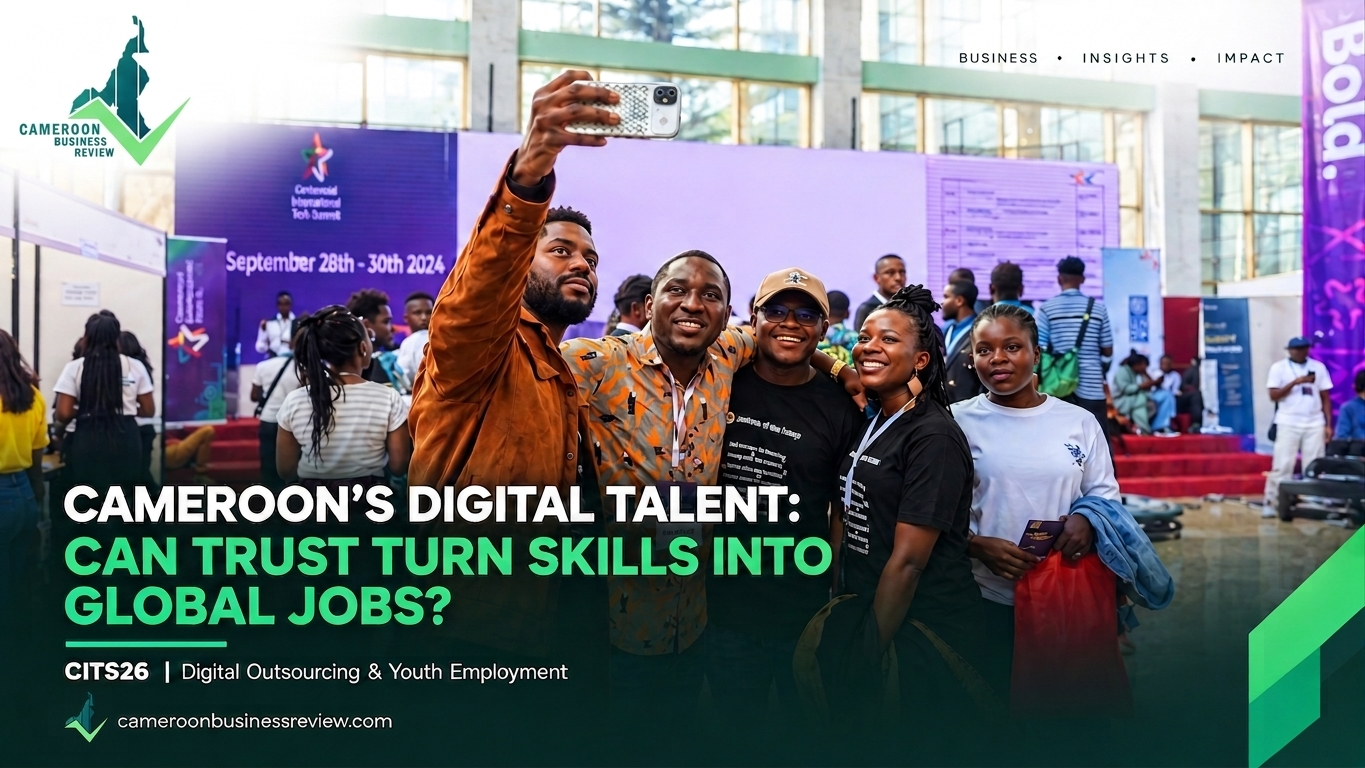
The event is scheduled for October 15–17 at the Palais des Congrès in Yaoundé, bringing together technology companies, entrepreneurs, investors, institutions and young professionals.
Its programme includes an innovation bootcamp, startup village, career activities, investor engagement and B2B opportunities. The organisers have also announced a national innovation programme spanning all ten regions. (CITS)
The regional dimension is particularly relevant.
Cameroon's technology conversation often centres on Yaoundé, Douala and Buea.
But if digital outsourcing is going to become a serious employment engine, talent discovery cannot stop at the country's traditional technology hubs.
A developer in Garoua should be able to compete for an international contract.
A designer in Bertoua should be able to build a global portfolio.
A data analyst in Maroua should be able to access the same digital opportunities as someone in Yaoundé.
The internet can theoretically remove geographical barriers. The ecosystem has to do the same.
Infrastructure Will Still Matter
There is, however, a practical limit to how far skills can take the outsourcing conversation.
Digital services depend on digital infrastructure.
Etta himself highlighted reliable internet and electricity as requirements for the outsourcing model. (Investir au Cameroun)
For a freelancer, an internet outage may mean a missed meeting.
For a company managing a large international customer-support contract, repeated connectivity or electricity problems can become a contractual and financial risk.
This means Cameroon’s outsourcing ambitions are connected to much larger infrastructure questions.
Better broadband, reliable electricity, digital payments, cybersecurity and cloud infrastructure are not simply technology-sector concerns.
They are becoming part of the country's export infrastructure.
Investors Are Watching the Same Ecosystem
There is another side to the conversation: capital.
At the same press conference, CITS promoter Ayuk Etta outlined an ambition for an ecosystem capable of producing around 100 startups and attracting up to €100 million in financing, equivalent to roughly CFAF65.6 billion. Those figures represent an ambition rather than capital already secured. (Digital Business Africa)
That distinction matters.
A technology ecosystem becomes economically meaningful when promising companies can move from idea to product, from product to customers, and from customers to scale.
Investors will ultimately look for evidence.
Who is paying?
How large is the market?
Can the company retain customers?
Can it operate profitably?
Can its technology scale?
Can its management team execute?
These are the same questions international clients will ask before outsourcing work to a Cameroonian company.
In both cases, credibility is the currency.
Cameroon’s Digital Reputation Will Be Built by Its Professionals
There is an important lesson for young people entering the digital economy.
The opportunity is not simply to acquire another certificate.
It is to become demonstrably reliable.
That means building real projects, maintaining professional profiles, collecting references, communicating clearly with clients and learning how international businesses operate.
A young developer who can show five completed projects is easier to evaluate than someone who only lists ten programming courses.
A digital marketer who can demonstrate actual campaign results has something concrete to sell.
A data analyst who can explain how a project moved from raw data to a useful business decision has a stronger professional story.
The same principle applies at company level.
Cameroon cannot market its digital talent solely through speeches about potential.
The strongest evidence will be contracts delivered, clients retained, products shipped and international partnerships sustained.
The Business Question After the Summit
The upcoming Cameroon International Tech Summit provides a platform for these conversations, but the real business story begins after the event.
Can the meetings produce contracts?
Can startups secure customers?
Can young professionals connect with employers?
Can international companies identify reliable Cameroonian service providers?
Can local technology companies move from small projects to larger international contracts?
Those outcomes will say more about Cameroon’s digital economy than attendance figures alone.
For Cameroon Business Review, that is the part worth watching.
The country does not need to convince the world that its young people have potential. It needs to build the systems and track record that allow international businesses to confidently pay for that potential.
Final Thoughts
Cameroon’s digital opportunity is increasingly shifting from “How do we train young people?” to “How do we connect trained people to markets?”
Digital outsourcing could become one answer.
But technical skills will only open the door. Professional reliability, communication, infrastructure and trust will determine whether international clients keep coming back.
The message emerging from the CITS26 press conference is therefore relevant well beyond the October summit.
If Cameroon wants to become a serious destination for remote digital work, its young professionals will have to build something more valuable than a CV: a reputation for delivering.
That reputation could eventually become one of the country's most important digital exports.