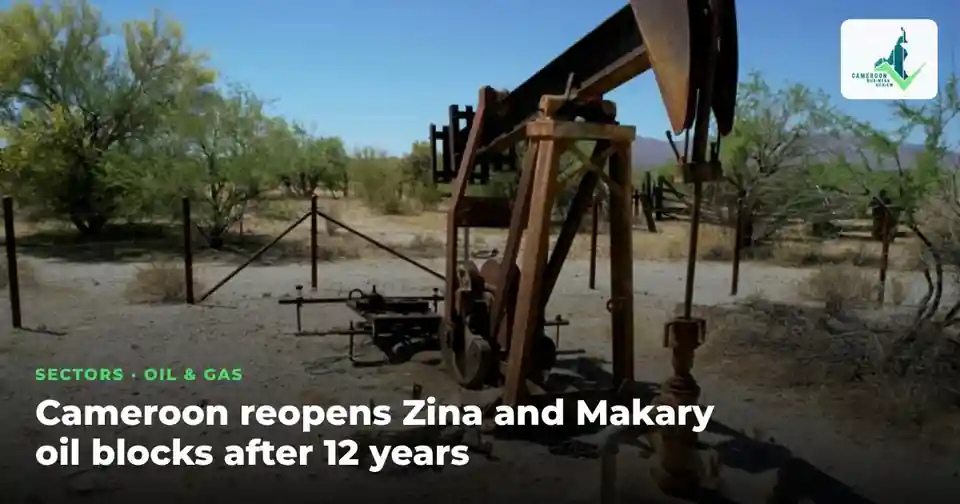
The Zina and Makary oil blocks in Cameroon's Far North are back on the market, twelve years after exploration there stopped because of Boko Haram attacks. The National Hydrocarbons Corporation (SNH) has included the two blocks in a new licensing round of six exploration areas, with bids due by May 28, 2027 and results expected in June 2027, according to Business in Cameroon.
The offer was presented on October 12 in Cape Town, South Africa, at African Energy Week, by SNH Deputy Director of Exploration Pierre Eric Nkoa Nkoa. All six blocks come with existing 2D seismic data, the report said.
What is in the round
The six blocks sit in three different basins:
- Zina and Makary, Logone-Birni Basin, Far North region. These were previously a single block, Zina-Makary, and have now been split in two.
- Ndian River and Bakassi, Rio del Rey Basin. Both went unawarded in the August 2025 round.
- Bomono and Kombe-Nsepe, Douala/Kribi-Campo Basin. Both also went unawarded in August 2025.
So four of the six blocks are re-offers from last year. The genuinely new element is the return of the Far North acreage.
Business in Cameroon did not publish surface areas for any of the blocks, and SNH has not published individual block sizes in the material reported so far.
The long pause on the Zina and Makary oil blocks
The history of Zina-Makary explains why this round matters and why it is complicated. According to Business in Cameroon:
- In 2009, Cameroon signed a production-sharing contract (PSC) for Zina-Makary with China's Yan Chang.
- On May 21, 2014, operations were suspended because of security threats from Boko Haram in the Far North.
- On March 10, 2016, SNH and Yan Chang signed a resolution formally recognising force majeure.
- The 2023 report of the Extractive Industries Transparency Initiative (EITI), published in December 2025, still listed Zina-Makary among Cameroon's four active exclusive exploration authorisations, with Yan Chang as operator.
- SNH's own newsletter, SNH Infos No. 78 covering 2024, said a special operations committee was expected to meet to lift the force majeure.
The reports do not say whether that committee met, whether the force majeure was formally lifted, or what happened to Yan Chang's 2009 contract. Those are the questions any bidder will ask first.
Why the legal status matters
An oil company bidding on an exploration block needs clean title. If an earlier production-sharing contract has not been terminated, or if the previous operator retains rights under force majeure, a new contract on the same ground invites dispute. SNH splitting the old block into Zina and Makary may be part of resolving that, but the agency has not said so publicly in the reporting we reviewed.
Clarity on this point would also help Cameroon's standing with transparency monitors. Business in Cameroon reported on October 15 that the country is moving to publish petroleum contracts and extractive data on a set timetable as it works to lift its EITI suspension.
How the last round went
The August 2025 round offers a guide to likely interest. SNH put nine blocks on the market. On April 24, 2026, it awarded five for production-sharing contract negotiations, according to Business in Cameroon:
- Murphy West Africa (US): Etinde Exploration, Tilapia, Elombo and Ntem
- Octavia Energy: Bolongo Exploration
That left four blocks unawarded, and all four are back in the current round. In other words, only two companies took acreage last time, and the offshore and coastal blocks they chose are the kind with existing infrastructure nearby. Onshore blocks in the Far North have no such advantage.
What investors will weigh
Three factors will decide whether the Far North blocks attract bids.
Security. The reason exploration stopped in 2014 was Boko Haram. Any company considering Logone-Birni will need its own assessment of the current risk in the Far North and of the cost of protecting crews and equipment.
Geology and data. The Logone-Birni Basin lies near the Chad border and is far less explored than Cameroon's coastal Rio del Rey and Douala/Kribi-Campo basins. Existing 2D seismic helps, but it is a frontier play.
Oil prices and state policy. With Brent around $108 on Monday, frontier exploration is easier to justify than it was a few years ago. The state has also been tightening its grip on the downstream sector, raising its stake in the national refiner, as we reported in our story on how Cameroon raised its Sonara stake to 98%. Investors will be reading those moves for signals about how the state intends to treat private partners.
The timeline
Bids close on May 28, 2027, with results expected in June 2027. That gives interested companies about seven months to review the data, assess the security situation in the Far North and get answers from SNH on the status of the old Yan Chang contract. The answer to that last question may matter more than the seismic.