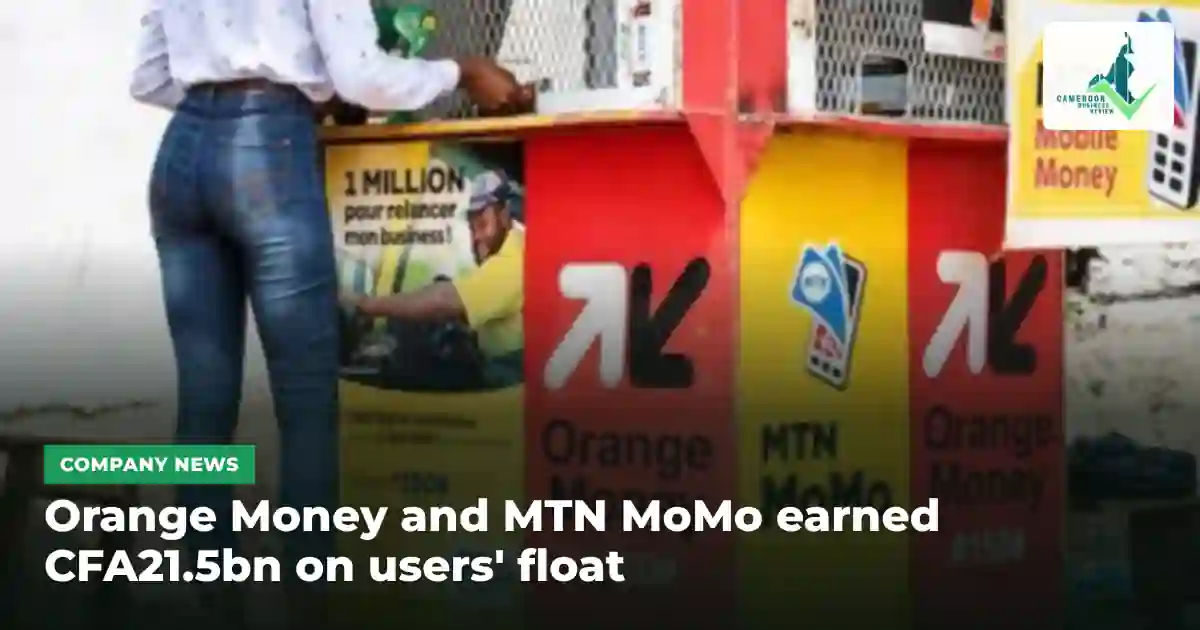
Cameroon's two largest mobile money operators earned CFA21.5 billion in 2025 from interest on customer money parked in banks. Orange Money took CFA9.9 billion and MTN MoMo CFA11.6 billion, according to the 2025 report of the National Economic and Financial Committee (CNEF), published on October 2, 2026 and analysed by Baudouin Enama of Business in Cameroon. The figures put a number, for the first time, on how much mobile money interest flows to operators rather than to the millions of people whose balances generate it.
Under CEMAC rules, wallet holders are not allowed to receive that interest. The operators are.
How the mobile money interest is earned
When a customer deposits cash at a kiosk, the operator must place an equal amount in a dedicated "safeguarding" account at a bank by the next day. The money still belongs to the customer, and the operator cannot lend it out or use it to fund its business. It must reconcile those accounts daily and keep them separate.
Banks pay interest on these accounts. CEMAC Regulation No. 04/18 of December 21, 2018 on payment services spells out who gets it. Article 54 states that "the safeguarding account earns interest paid by the account-holding bank to the payment institution." Article 9 forbids payment institutions from paying interest to users on electronic money. Put together, the two rules allow operators to collect the interest while customers receive none.
The numbers behind the CFA21.5 billion
The CNEF report, which draws on COBAC banking data, gives the following figures for December 31, 2025:
- Funds safeguarded in banks: CFA193 billion for Orange Money across nine banks and CFA280 billion for MTN MoMo, a combined CFA473 billion.
- Money owed to users: CFA162.3 billion for Orange Money and CFA229.3 billion for MTN MoMo.
- Coverage: 119% for Orange Money and 122% for MTN MoMo, leaving surpluses of CFA30.7 billion and CFA50.7 billion, CFA81.4 billion in total.
- Transaction volume: CFA32.667 trillion combined in 2025, up 13.7% from 2024. Orange Money handled CFA17.176 trillion and MTN MoMo CFA15.491 trillion.
The report does not explain the CFA81.4 billion surplus above what is owed to customers, and Business in Cameroon cautions that it cannot be treated as profit.
Which banks hold the money
Orange Money's largest deposits sit with AFG Bank (CFA56.9 billion), Ecobank (CFA39.6 billion) and BGFIBank (CFA28.5 billion). MTN MoMo's largest are with CCA (CFA58.5 billion), Afriland First Bank (CFA53.9 billion) and Access Bank (CFA49.3 billion).
Four banks hold money for both operators. Ecobank has CFA74.1 billion in total, CCA CFA66.1 billion, Access Bank CFA60.4 billion and UBA CFA54.4 billion. For some lenders this is a meaningful share of their funding. Access Bank's CFA60.4 billion is about 22.2% of its CFA272.5 billion in gross deposits, and Ecobank's CFA74.1 billion is about 16.1% of its CFA461.6 billion.
The rates banks pay
Rates vary widely. For Orange Money, BGFIBank paid 6.6%, CCA 6.5% and AFG Bank 6%, while BICEC paid 3%. For MTN MoMo, rates ran from 4.35% to 6.5%, with the report listing a bank named "AFB Bank" at 5.75% to 6%. Business in Cameroon notes the report does not explain how "AFB Bank" differs from Afriland First Bank.
Why this matters for customers and banks
For mobile money users, the issue is fairness. Customers who keep balances in their wallets are, in effect, lending money to banks through the operator, but the return goes to the operator. In some other markets, regulators have pushed for part of this interest to be passed on to customers or spent on public-interest goals. CEMAC's current rules do not require either.
For banks, mobile money float is a cheap and stable source of deposits. Competition for it helps explain the spread in rates, with some banks paying more than double what others pay.
For the operators, the interest is a steady earner on top of transfer and withdrawal fees. Interest income on funds that customers cannot touch is a low-risk revenue stream.
What the report does not say
The CNEF report leaves several gaps, which Business in Cameroon flags:
- It gives no breakdown of how the interest is accounted for, what costs or taxes apply, or how much reaches net profit.
- It does not say whether money moves between the payment subsidiaries and their parent telecom companies.
- It reports year-end balances only, without average balances, so effective returns cannot be calculated.
- It does not explain the gap between trillions of francs in annual transactions and the much smaller balances held at year end.
Mobile money has become core infrastructure in Cameroon, alongside the fibre and connectivity projects we track, such as the CAMTEL and SIC fibre deal for public housing. As balances grow, the question of who earns the interest on them will matter more to regulators at BEAC and COBAC, and to the customers whose money is involved.